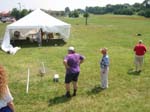
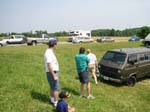
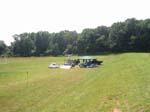
| Carasat Field Day 2002 Photos by Ed Cabic & Dave Anderson 6/22-23/02 |
What a great time we had! We made 24 contacts for W3AO (listed in table below) and we also obtained the 100 point bonus for working a satellite.
Here is how it happened.
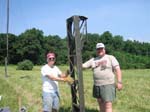
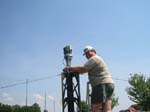
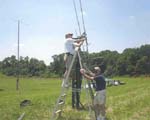
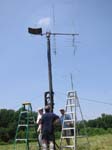
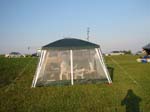
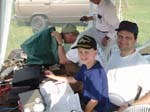
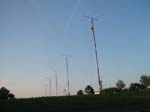
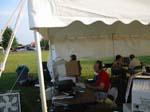
We gathered Saturday morning June 22, 2002, to do the set up. Although satellite antennas do not have to be up high as do conventional HF antennas, we accepted the PVRC's offer of a rocket launcher antenna to put our antenna about 10 feet up in the air. The first photo above shows Bernie setting up the base unit of the tower which would then have three guide wires attached at the top of that base unit. Then Bernie added Art's az-el rotator which is a Kenpro KR400/KR500 AZ/EL combo. Then in photo 3 Art is mounting the Yagi antennas on the cross beam. Photo 4 shows the three antennas mounted up on the tower. On the left is the "barbecue" dish to hear the 2.40 gig S-band downlink from AO-40 with its preamp. This was provided by Don. It is a 2.4 ghz - Parabolic Grid with factory yagi feed, with the backplane covered with a copper reflector, effectively making it a dish. The downconverter is a Down East Microwave Preamp + 2400-->144 downconverter. The yagi in the middle is a 435 Mhz - M2 432CP30 circularly polarized yagi and it is used for the 435.550-435.800 MHz uplink to AO 40 as well as for other satellites. Finally the yagi on the right with the longer elements is the 144 Mhz - M2 2MCP14 circularly polarized yagi.
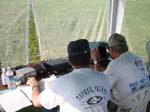
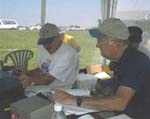
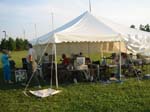
Art brought his tent which we set up to enclose the operating station which included his laptop computer and the Cara club's Yaesu FT-847 radio. Inside we also had Art's Yaesu G5400B control box to control the az and el motors. This controller is run by a Zl2AMD Unitrac unit controlling the rotators (but the radio tuning part was non-functional -- see below). For information on a later model Unitrac controller and the software see the UNI_TRAC 2000 .
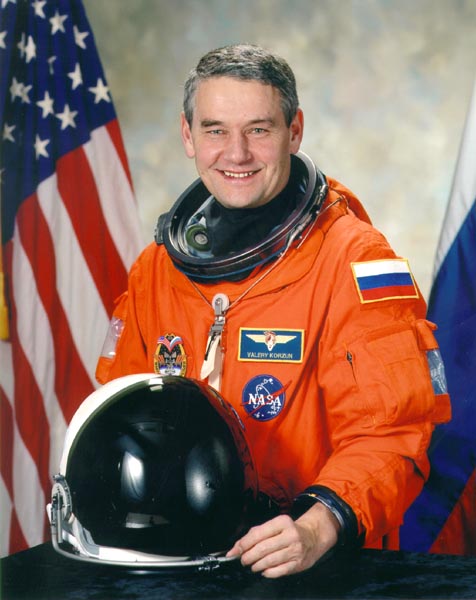 |
The contest began at 2 pm. The first bird we tried to work was the International Space Station (ISS) at its 2:50 pm pass. Its maximum elevation was 9 degrees. We heard the Russian Cosmonaut Valery Korzum, but we did not make any contact. |
Next was an attempt for FO-20 at about 3:25 pm. Again its maximum elevation was only 9 degrees and we did not hear anything. After the pass I talked to Bernie about needing a pream for our 440 antenna. Bernie was operating the APRS station and the Visitor Information station with Jon. Among all the tools and stuff that Bernie brought for Field Day was a 435 preamp. He let us use it and better results were obtained as reported below.
The next pass was the ISS at about 4:26 pm. Rod was working the radio and at 4:31 we heard Valery acknowledging our call sign of "W3 Atlantic Ocean". This was a GREAT moment which we shared with the other Field Day participants. However, at the time there was a nagging concern that the ISS was not an "amateur radio satellite." We certainly logged it in, but the worry/concern was that we may not have yet made our first "satellite" contact.
Since Field Day we have more info on this contact. Stan Vandiver W4SV has posted to the Sarex listserv the stations that his VOX recorder heard making contact with ISS. Click on "posted" in the previous sentence and see his report - the 2030 UTC pass has our "W3 Atlantic Ocean."
Frank Bauer, KA3HDO, the ARISS Chairman posted a reply to the Sarex listserv on June 27 on "Field Day and ISS." Click on "posted" and see his remarks that ARRL has settled on 1A as the category for the ISS. So it is a legitimate Field Day contact!
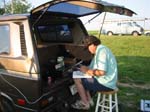
Getting back to the real time report of activities, we next tried to work FO-20 on its 5:09 pm pass. This time we had Bernie's 435 MHz preamp and maximum elevation was 49 degrees. We heard ourselves on CW, but no contact was made although Art made many attempts. Photo 6 was taken at about this time. Art is using a shield to view his laptop and keep the sun's glare off of it. The laptop gives the az and el values for FO-20 so Rod can control the antennas. It seems Murphy (of Murphy's Law -"things will always screw up") was in charge this afternoon since the keps Art had were not the latest and this may have had an impact on out initial attempt to work ISS. After obtaining newer keps both NOVA, Predict and Unitrac agreed on az/al and the Unitrac seemed to properly track the satellites. Unfortunately, because our Unitrac box was an older unit, and the software we were using was the newer software, the Full Doppler Tuning feature did not work (it crashed the program). So we tuned the radio manually. We found it easy to set the transmitter on a frequency, and key CW while we tuned for our return signal. Once we found it, it was easy to maintain close coordination between Tx and Rx and our contacts went smoothly.
By 5:50 pm we worked FO-29 which operates in the same way and with the same frequencies as FO-20. Rod was working the radio and at about 6 pm we made a QSO with K4BFT in Alabama. Now we knew we had at least one "satellite" contact.
We took a dinner break and our attempts to work AO-27 at 7:50 pm and AO-10 at 8:30 pm were not successful. Art commented later that to operate AO-10 you need a very good station with amps and preamps which is almost at the level needed to work AO-40.
The big hope for Field Day was to be able to work AO-40 since may hams who work satellites had reported on the Amsat bulletin board that they intended to work this bird. However, the pass did not begin until about 10 pm. Then at that time we began to look at the "MA" (Mean Anamaly) for the pass and found that the voice mode for the satellite would not be turned on until about 1:30 am Sunday morning.
The late night shift was to be done by Art and Don who was to first remain at his home QTH to monitor the signal with his base station.
The bottom line was that they worked until 3:30 am checking out the equipment but they were not able to make any contacts. Part of the problem may have been the poor squint angles for the bird at that time.
When I arrived at about 8:30 am on Sunday, the computer running the antenna controller was keeping the antennas pointed to AO-40. Bernie joined me and when we listened over the band we heard many stations. Bernie began calling CQ and at 8:49 Bernie had K6HAI in San Diego. Next came ND4D in Atlanta Georgia. We called Art and told him the bird was active.
Art began operating at 9:30 am and in tests he found the transmit SWR was a high 2.1. We were not hearing ourselves very well on voice. John came by and suggested that under these circumstances we should try to use CW to make the contacts. Below is a table of all of our contacts and you will see John was able to make 12 CW contacts before we started to find that we had worked all of the stations that we were then hearing on the bird.
| UTC | Local | Station | Report | Satellite | Mode |
| Saturday | |||||
| 20:31 | 4:31 | RS0ISS | (1A) | ISS | voice |
| 22:00 | 6:00 | K4BFT | 5A AL | FO 20 | voice |
| Sunday | |||||
| 12:49 | 8:49 | K6HAI | 3A San Diego | AO 40 | voice |
| 13:04 | 9:04 | ND4D | 7A GA | AO 40 | voice |
| 13:56 | 9:56 | N4TP | 2A WCF | AO 40 | cw |
| 14:00 | 10:00 | N4ZQ | 1A WCF | AO 40 | cw |
| 14:02 | 10:02 | K5XB | 1A NTX | AO 40 | cw |
| 14:03 | 10:03 | K7KCS | 1E WWA | AO 40 | cw |
| 14:10 | 10:10 | NM2A | 1E WNY | AO 40 | cw |
| 14:15 | 10:15 | W6ZQ | 1D OR | AO 40 | cw |
| 14:21 | 10:21 | K6PUD | 22A SC | AO 40 | cw |
| 14:24 | 10:24 | K4BFT | 5A AL | AO 40 | cw |
| 14:26 | 10:26 | WA4MM | 3A VA | AO 40 | cw |
| 14:29 | 10:29 | W9INL | 2A IN | AO 40 | cw |
| 14:31 | 10:31 | W4IY | 8A VA | AO 40 | cw |
| 14:44 | 10:44 | W1PA | 3A WMA | AO 40 | cw |
| 14:50 | 10:50 | N4TP | 2A WCF | AO 40 | voice |
| 15:00 | 11:00 | N0PKJ | 1A CO | AO 40 | voice |
| 15:01 | 11:01 | VE7SUN | 7A BC | AO 40 | voice |
| 15:05 | 11:05 | K5XB | 1A NTX | AO 40 | voice |
| 15:11 | 11:11 | K2BAR | 2A NNJ | AO 40 | voice |
| 15:13 | 11:13 | W7KKE | 1E OR | AO 40 | voice |
| 15:19 | 11:19 | K2BMI | 1B SNJ | AO 40 | voice |
| 15:22 | 11:22 | W2LV | 3A NNJ | AO 40 | voice |
After we were done working the CW stations Art went back to trying voice
contacts. By now the squint angle was better and Art was able to snag 8 more
voice contacts. This also included a voice radiogram from N4TP.
When we heard N4TP at 10:50 am our first thought was that it was a "dupe" (duplicate) since we had worked them at 9:56 am. However, that earlier contact was on cw so the voice contact at this later time was a proper contact on a different mode.
After Field Day Steve Greene KS1G posted his report (click on report) on the Amsat DC list serv. He was doing satellite operation for WA4MM (the NoVAQRP group) and he has a web page of photos from his site. We worked Steve at 10:26 am on cw.
All in all, we were very pleased. Next year Art plans to have a helix or patch feed for the 2.4 Ghz antenna, and we may experiment with other downconverters. Also, the Unitrac problem will be solved one way or the other. Thanks to Art for his technical comments included in this report.
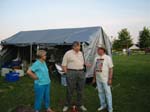
Who was there in the tent from
Carasat
Art N3OY
Bernie K3BAZ
Dave WA3WZX
Dave N3OYF
Don W4VQA
Ed N2EC
Joe N3FKQ
John W3GJN
Jon KF3O
Pete K3IN and son Paul
Rod KA3BHY and son Russell (no call sign yet)
In the Power Station from
Carasat
Bob KC3VO